Most of the attention around SpaceX's upcoming IPO has focused on Starlink's subscriber growth and the company's dominance in commercial launches. But there is another dimension to SpaceX's business that gets less coverage and may matter just as much to its long-term valuation.
SpaceX has quietly become the backbone of America's space defense infrastructure.
The company holds $22 billion in government contracts. It fulfills 97% of Space Force PLEO task orders. It operates a classified spy satellite network for the National Reconnaissance Office. And it is now the leading candidate for Golden Dome — a Pentagon initiative to build a 600-satellite missile tracking and defense constellation.
SpaceX Is the Leading Candidate for a $2 Billion Missile Defense Constellation
In early 2026, reports emerged that the Pentagon would award SpaceX a contract worth approximately $2 billion to help develop the Golden Dome missile defense system. The program calls for a constellation of roughly 600 satellites designed to detect and track missile launches globally — a capability that currently relies on aging ground-based and high-orbit systems.
The fiscal year 2026 defense appropriations bill includes $13.4 billion for space and missile defense systems, reflecting the Pentagon's accelerating shift toward space-based national security infrastructure. SpaceX, with its unmatched launch cadence and satellite manufacturing capability, is positioned to capture a significant share of that spending.
This contract would join an already substantial government portfolio.
$22 Billion in Government Contracts — and Growing Every Year
SpaceX's relationship with the U.S. government is deep and expanding.
The company holds a $5.9 billion Pentagon contract for 28 national security launches through 2029. It secured $845.8 million in Space Force missions for fiscal year 2025 alone. It operates a $1.8 billion classified satellite network for the NRO. And it remains NASA's primary commercial crew and cargo provider, with contracts supporting the Artemis program's return to the Moon.
These government contracts provide something that commercial revenue alone cannot: long-term revenue visibility with a counterparty that doesn't default. For investors evaluating SpaceX ahead of its IPO, this government revenue stream represents a floor beneath the company's valuation — recurring, contractually guaranteed income from the most creditworthy customer on Earth.
“SpaceX's market position can only be described as an emergent monopoly.”
Secure, Free & No Obligation
165 Launches. 32 Reuses on a Single Booster. No Competitor Is Close.
The Pentagon's reliance on SpaceX is not arbitrary. It's a function of capability that no other provider can currently match.
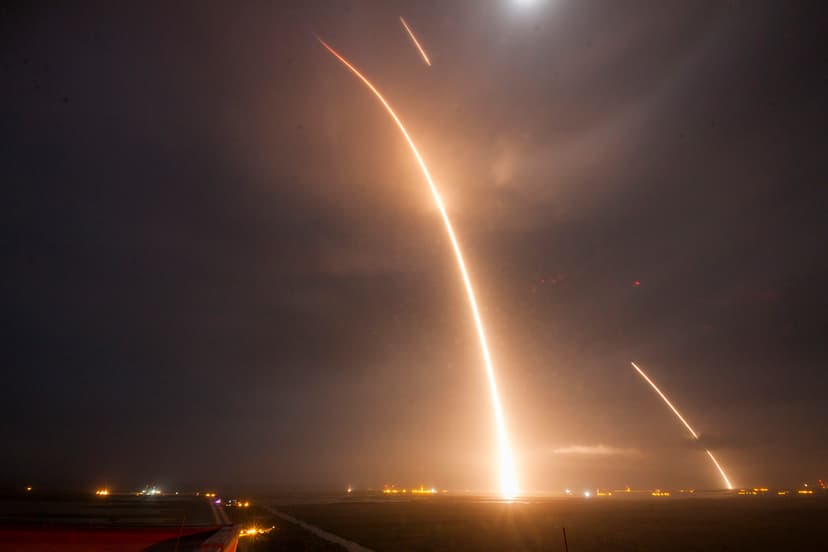
SpaceX completed 165 orbital launches in 2025 — more than every other nation combined. Its Falcon 9 is the most reliable operational rocket in history, with 162 of 165 successful booster landings last year. Its cost per kilogram to orbit is a fraction of what legacy providers like United Launch Alliance charge.
Blue Origin's New Glenn has completed just two flights. Rocket Lab's Neutron remains in development. No competitor has demonstrated the launch cadence, reliability, or cost efficiency required to fulfill large-scale national security contracts at the pace the Pentagon demands.
This competitive moat extends to satellite manufacturing. SpaceX produces Starlink satellites at a scale and cost that no other company has replicated. That manufacturing capability — building satellites at volume — is directly transferable to military satellite production for programs like Golden Dome.
Commercial Growth + Government Revenue = a Valuation Story Wall Street Hasn't Fully Priced
SpaceX is expected to go public this summer at a valuation exceeding $1.5 trillion. The government contract portfolio adds a dimension that most coverage of the IPO has underemphasized.
Technology companies going public are typically evaluated on commercial revenue growth and total addressable market. SpaceX has both — Starlink's $10.4 billion in revenue and the orbital AI data center initiative provide the growth narrative. But the $22 billion in government contracts provides something rarer: durable, non-cyclical revenue backed by the full faith and credit of the United States.
For a company approaching the public markets, that combination — explosive commercial growth paired with stable government revenue — is unusual and valuable. Morgan Stanley has projected SpaceX could be worth over $350 billion on the Starlink business alone, before accounting for launch or defense revenue.
Everyday Investors Can Now Get In Before the IPO — Starting at $500
Pre-IPO investing used to be reserved for institutional investors and accredited individuals. Most opportunities required minimums of $10,000 or more. If you weren't a Wall Street insider, you were locked out.
That's no longer the case. Jeff Brown has published research showing how regular Americans can position themselves before the SpaceX IPO, starting with as little as $500. No accredited investor status. No connections on Wall Street. The process is as simple as buying any other stock.
You Don't Need a Security Clearance. You Need Timing.
If you're reading about classified satellite networks and billion-dollar defense contracts and thinking "This isn't for me" — take a step back.
No finance degree or Wall Street connections required. The process for positioning before the SpaceX IPO is designed for people who've never made a pre-IPO investment before.
The minimum starting position is $500. That's not about going all-in on a single bet. It's about adding a category of investment to your portfolio that was structurally unavailable to you during every previous mega-IPO.
And if you're skeptical — good. Pre-IPO positions are less liquid and more uncertain than public stocks. No outcome is guaranteed. But the access? That's new. And the window? That's closing.
What Jeff Brown's Free Briefing Covers
Jeff Brown spent over two decades as a senior executive at Qualcomm, NXP Semiconductors, and Juniper Networks — companies generating more than $50 billion in combined annual revenue. His research on the SpaceX IPO includes analysis of the government revenue stream and what it means for the investment thesis.
Brown recently published a free video presentation covering his complete SpaceX research — what most analysts are missing, how everyday investors can position, and the risks.
Brown publishes his ongoing research through The Near Future Report.
The S-1 Filing Could Come This Month — and Access Narrows After That
Bloomberg reported in late February that SpaceX was weighing a confidential S-1 filing as early as March. Once that filing lands, the IPO process is formally underway. Institutional demand floods in. Pre-IPO pricing adjusts upward. The window that exists right now — where everyday investors can position alongside institutions — begins to close.
The Pentagon contracts aren't going away. The launch monopoly isn't going away. The Starlink revenue isn't going away. The only thing that's going away is the access window.
The presentation is free — for now. Once the S-1 is filed, the window closes. That filing could come any day.