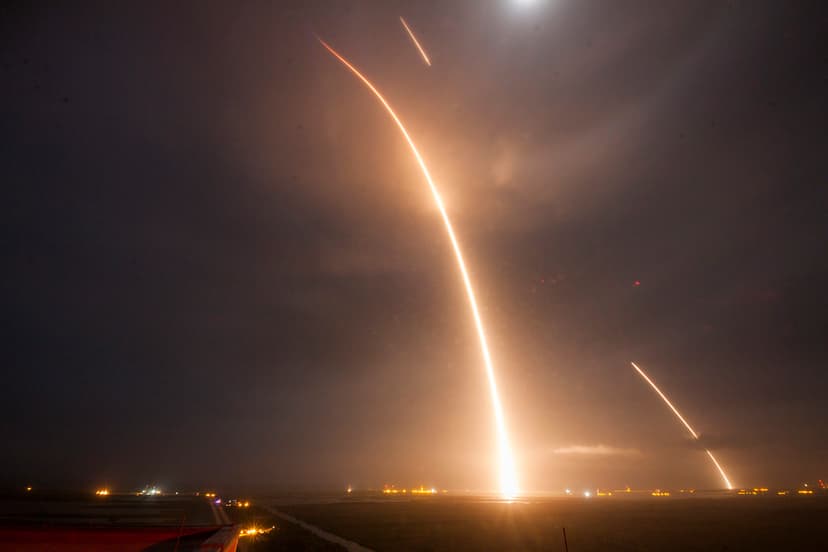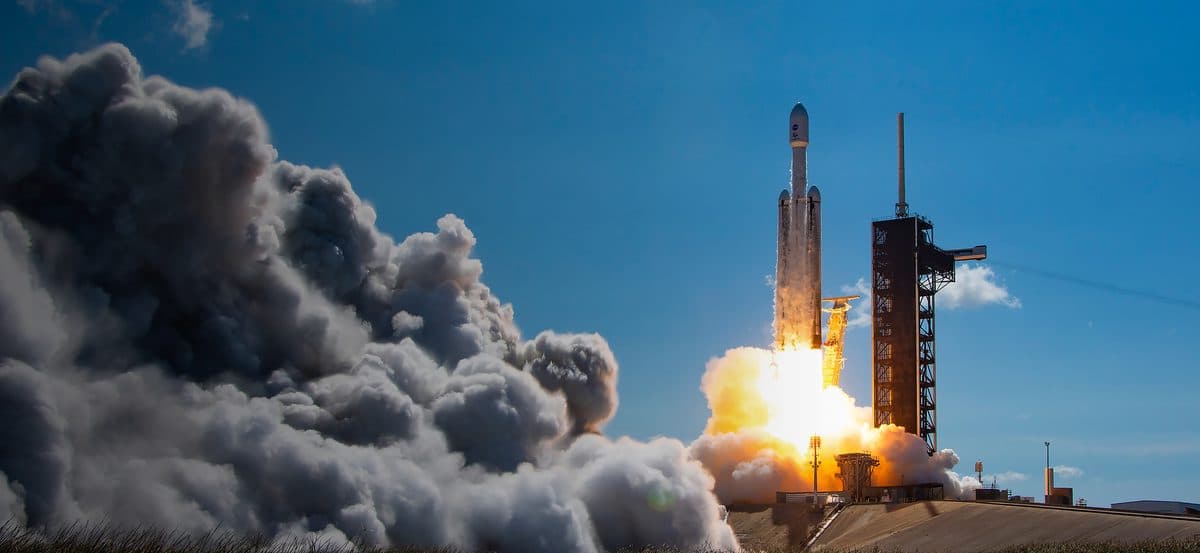
In 2025, SpaceX completed 165 orbital launches. That is not a rounded number. It is not an estimate. It is the sixth consecutive year the company broke its own record.
To put that figure in context: SpaceX launched more missions than every other country on Earth combined. It represented approximately 85% of all U.S. orbital launches. It nearly doubled China's total mission count. A single SpaceX booster was reused 32 times.
No company in the modern aerospace industry has ever achieved this level of operational dominance. And for the first time, everyday investors are about to have access to it.
Reusable Rockets Cut Launch Costs by 65% — and Starship Will Cut Them by Another 90%
The foundation of SpaceX's monopoly position is economics.
Before SpaceX, orbital launches were disposable operations. Each rocket was built, launched once, and destroyed — either burning up in the atmosphere or sinking into the ocean. The economics were comparable to scrapping a commercial airplane after a single flight.
SpaceX changed the equation by developing reusable rockets. Its Falcon 9 boosters now land themselves after launch and fly again — up to 32 times on a single booster. This innovation cut launch costs by approximately 65%, bringing the price to roughly $2,720 per kilogram to orbit.
Its next-generation vehicle, Starship, is designed to reduce costs by an additional 90%. Musk has stated that Starship will make "putting large satellites into space very cheap" — enabling the deployment of thousands of satellites per launch.
The competitors are years behind. Blue Origin's New Glenn completed its first successful flight in January 2025 and has flown just twice. Rocket Lab's Neutron rocket remains in development. No other commercial provider can match SpaceX's cost structure, flight cadence, or reliability record.
“SpaceX's market position can only be described as an emergent monopoly.”
The Launch Monopoly Powers a $10.4 Billion Revenue Machine — and an AI Satellite Network
SpaceX's launch dominance has enabled the construction of something far more valuable than a launch business: a global infrastructure network.
Starlink, the company's satellite internet division, now operates more than 9,500 satellites and serves over 10 million subscribers across 150 countries. Revenue reached approximately $10.4 billion in 2025 — making it the fastest-growing telecommunications operation in history.
But Starlink's real value may extend beyond internet service. In January 2026, SpaceX filed with the FCC to deploy up to one million orbital AI data center satellites. The filing, submitted weeks after SpaceX's merger with xAI at a combined $1.25 trillion valuation, suggests the existing Starlink constellation is the foundation for something much larger.
The company's ability to manufacture satellites at scale, launch them at the lowest cost in the industry, and operate a global orbital network creates a competitive position that no other company can currently replicate.
Secure, Free & No Obligation
$1.5 Trillion Valuation. $22 Billion in Government Contracts. The IPO Is This Summer.
SpaceX is expected to go public this summer at a valuation exceeding $1.5 trillion. Goldman Sachs, JPMorgan Chase, Morgan Stanley, and Bank of America have been selected as lead underwriters.
“This IPO could raise more money than all 90 IPOs in 2025 combined.”
Morgan Stanley has projected SpaceX could be worth over $350 billion on its Starlink business alone — before accounting for the core launch monopoly, the AI satellite initiative, or government contracts totaling $22 billion. The confidential S-1 filing with the SEC could come any day.
Everyday Investors Can Now Get In Before the IPO — Starting at $500
For decades, a company like this was completely off-limits to everyday investors before IPO day. Pre-IPO investing required accredited investor status, minimum investments of $10,000 or more, and connections to venture capital networks. If you weren't a Wall Street insider, you were locked out.
That's no longer the case. Jeff Brown has published research showing how regular Americans can position themselves before the SpaceX IPO, starting with as little as $500. No accredited investor status. No connections on Wall Street. The process is as simple as buying any other stock.
You Don't Need to Understand Rocket Science. You Need to Understand Monopolies.
If this feels too technical or too big — it's simpler than it looks.
SpaceX has 85% market share in an industry with no viable competitors. It has $10.4 billion in recurring revenue. It has $22 billion in government contracts. And it's about to go public for the first time.
You don't need a finance degree to see what that combination means. The process is straightforward and starts at $500. It's designed for people who've never done this before.
And if you're skeptical — good. Every investment carries risk. Pre-IPO positions are less liquid than public stocks, and there's no guarantee of any particular outcome. But the company's dominance is measurable, the IPO is confirmed, and the access window is real.
What Jeff Brown's Free Briefing Covers
Jeff Brown spent over two decades as a senior executive at Qualcomm, NXP Semiconductors, and Juniper Networks — companies generating more than $50 billion in combined annual revenue.
Brown recently published a free video presentation covering his complete SpaceX research — what most analysts are missing, how everyday investors can position, and the risks.
Brown publishes his ongoing research through The Near Future Report.
The S-1 Filing Could Come This Month. The Monopoly Isn't Going Anywhere — But the Access Window Is.
Bloomberg reported in late February that SpaceX was weighing a confidential S-1 filing as early as March. Once that filing lands, institutional demand accelerates, media coverage goes wall-to-wall, and the pre-IPO window narrows significantly.
The 165 launches aren't going away. The 85% market share isn't going away. The $10.4 billion in revenue isn't going away. The only thing that's going away is the window to get positioned before the rest of the market piles in.
The presentation is free — for now. Once the S-1 is filed, the window closes. That filing could come any day.